Travelreport 12 Tarashing (Pakistan, 13-10-2000)
till Gilgit (Pakistan, 15-10-2000)
My plan was to go back to Astore
when they told they wanted to go cross the Deosai plains. I told then this was
going to get difficult so late in the season but they wanted to give it a try.
In Skardu I decided not to cross the plains but when they offered me to go
together I accepted. We would just see how far we were going to get and agreed
to stay together.
We got up early the next morning and left Tarashing. When I drove away I noticed
having a flat tyre again. I pumped it up and found out it was only loosing air
slowly. Because we were driving off-road the tyre pressure wasn't really
critical so pressurising it once a day would do fine and I could postpone the
repair the tyre to Skardu again. Just before Astore was the exit to Chilam, the
last village before the Deosai plains and we filled up our vehicles with fuel
completely.
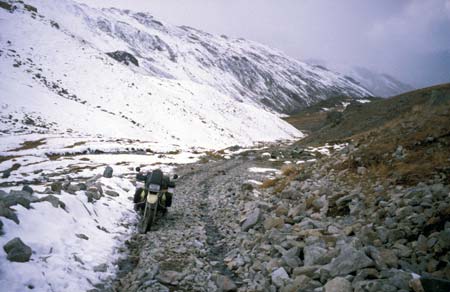 A rough track leading up to the pass
 |
The track to Chilam wasn't
difficult, basically the same as the track to Astore. Every 20 km I stopped and
waited for the Danish 4WD before we continued. In Chilam we had to register and
had a very simple lunch and tea at the local 'hotel' sitting outside in the sun.
After the lunch we took the track onto the plains. From the village it went
steep up. But driving up wasn't as difficult as it looked. Directly we were
stopped by a roadblock. We were about to enter Deosai National Park and had to
pay an entry-fee of Rp. 200 (USD 4) each but they had ran out of tickets and
could only issue us a Rp. 20 receipt (entry-fee for locals) and wrote an extra 0
behind it. We didn't accept this (he could then put Rp. 180 in his own pocket)
so it ended up that he gave me a little note we had to show at the entrance of
the Park on the Skardu side (and probably pay there). The road wasn't really
difficult to drive but the scenery was absolutely brilliant. So pure!!! We
stopped quite often to take pictures or just to simply enjoy the scenery. Slowly
we climbed towards the pass at 4260 metres. Below 3800 metres there were no
problems but then it started to get rough. Real steep parts and a big loose
stones made it difficult for my bike but I managed to get through it myself most
of the times and if not, I just waited for the car and Poul helped me to push
through. But it was hard working and at 4000 metres you run out of breath very
quickly so I had to stop frequently to catch my breath back again.
After the stones (you kept thinking:
after this difficult part it's getting easier) it was actually getting worse.
Mud was my biggest enemy now. Were the steep parts or loose stones possible to
cross when you handled the bike well, in the mud you're slipping and sliding
away and there's nothing you can do about it. I had to keep the throttle open to
avoid digging myself in and to climb towards the pass. Because of the mud I had
to put my feet just above the ground ready to put them down to keep the balance
when I slipped away. This is at 4000 metres very exhausting thing to do and I
had to stop frequently. That my bike fell into the mud a couple of times didn't
really help me to catch my breath but luckily I had some help from Poul. Mud was
all over the bike (and over me as well), so this was a really difficult (and
exhausting) trip.
 Camping at a cold pass at 4260 metres altitude
 |
However I didn't want to turn around as we would never reach Chilam before dark
and behind us it started snowing. Also it was only another couple hundreds
metres to the pass. Maybe it was getting better after the pass but more
important: just after the pass there was a lake were we could camp and spend the
night.
After having a good sleep we would decide what to do tomorrow. When we reached
the lake we weren't alone up there. A Japanese had put up his camp there as well
and invited up for some tea. After the tea we put up our tents before it was
getting dark and we also had to hurry because it started to snow here as well. I
dressed myself warmly and when we asked if we could use his big tent to prepare
our meal (protected against the snow and icy wind) he insisted to have diner
with him as his cooks were already cooking for us as well.
When we had dinner suddenly a telephone started ringing. It appeared to be a
satellite telephone. He was part of a Japanese expedition. Tomorrow two Japanese
wanted to fly over Mt. Nanga Prabat (8125m) in a hot air balloon. He stayed on
the pass to follow their track and pick them up when they landed somewhere on
the plains. So with the telephone they stayed in touch with each other.
Their original plan to fly over K2
Mountain but the Chinese authorities refused to give them permission to enter
Chinese airspace. After diner and a couple of teas we went to bed as it was
getting very cold. My tent was already snowed in partly and I closed all the
zips I could find. Dressed in thermals and with 2 pair of socks I went inside my
sleeping bag and tied it up completely.
I wasn't cold that night when temperatures dropped below -15°C. The next morning
I woke up early and found it difficult to get out of my warm sleeping bag. The
Japanese guy was already up and had had contact with his friends. They were
definitely departing this morning.
 Sliding through the melting snow down on two wheels
 |
We had breakfast with the Japanese
as well and we decided to turn back to Chilam. The Japanese came from Skardu
yesterday and said we had to drive through the mud for another 4 hours. Also we
had to cross two rivers. No problem except that they removed both bridges a
couple of days ago to protect them against the winter. We could cross through
the river but the locals said that the ground clearance of the Danish 4WD was
not enough to get through. We decided to wait for the balloon to pass but left
when we heard that the balloon was drifting south instead of east so we would
never see it. The Japanese quickly packed his stuff and departed trying to catch
up with the balloon. There were no roads or jeep tracks to the south so this was
getting difficult. Also the balloon had to make a forced landing before entering
Indian airspace as the Indian-Pakistani border here is extremely sensitive. We
didn't know how this all ended but in the worse case the balloon had to be
picked up by Pakistani army helicopter. In the meantime we had problems as well,
especially me. The sun made the snow melt which increased the amount of mud. I
stored all my luggage in the car so it was easier for me to get through.
Nevertheless I fell several times and had to rest every 200 or 300 metres. After
2 hours we got a long rest and managed to have covered only 6 kms.. My rests
gave the Danish plenty of time to take pictures and video's (from me as well).
With their digital camera they also shot pictures so I was able to send these
pictures around attached on an email later back in Gilgit.
After our rest it was getting easier
fast as we got below 3800 metres where it didn't snow that much and the sun
already dried up the mud. So Chilam was reached without further problems. Yeh,
one problem left when we passed the roadblock to the National park again. But
because he still hadn't any tickets we got through without paying anything.
We had some tea at the same hotel and drove back to Astore without any further
problems. The next day we drove all the way back to Gilgit to spend there a
couple of days to relax after the exhausting trip and to see the pictures taken.